
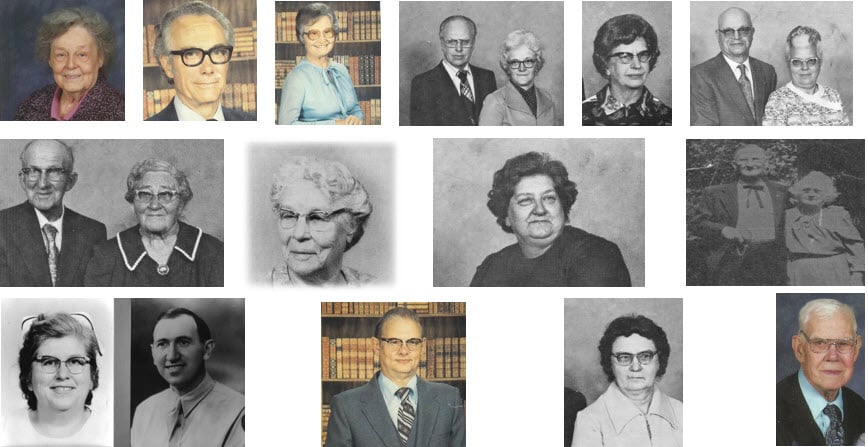
The Adventist message was first preached in Van Wert County, Ohio, near Elgin, in 1886. Four years later, in 1890, a layman from Lakeview came to Lima to assist the believers from Elgin in organizing a series of evangelistic meetings at the corner of East Elm Street and Central Avenue.
The meetings were successful, resulting in several new believers. The newly formed congregation began holding weekly worship services in a room above the Lima Fire Station on East Kibby Street. During this period, J. E. White, the son of Ellen G. White, visited one of the Sabbath School services held there. From the available records, it appears that the first Lima Seventh-day Adventist Church was officially established in 1900. Among the names recorded in the church’s oldest record book are Minnie Long and Nora Watt, two women who would play significant roles in the congregation’s history.
In September 1915, the Ohio Conference recommended that the church be disbanded because false doctrines had begun to influence the congregation, creating serious division among the members. Following this action, Minnie Long and Nora Watt faithfully continued holding Sabbath School and prayer meetings in Minnie Long’s home for approximately five years.
During this time, Minnie’s husband, Grant Long, began attending the meetings and was baptized in 1919. He became a strong pillar of the congregation when the church was reorganized in the Long family home. In 1920, the small group of believers purchased a church building at the corner of East Eureka and Scott Streets. The building seated approximately 30 to 50 people.
An evangelistic campaign conducted at Memorial Hall during 1936–1937 resulted in significant church growth. In October 1937, the congregation sold the Eureka and Scott Street church for $2,300 and used the proceeds to purchase the former Lutheran church at the corner of West Spring and South Pierce Streets for $4,800. With seating for more than 300 people, the new building provided much-needed space for the growing congregation.
The first worship service in the new church was held on December 11, 1937, and the building was formally dedicated on February 5, 1938. During the dedication service, special recognition was given to Elder Van Horn and others who had pioneered the Adventist work in Lima approximately 52 years earlier.
Pastor Edward Schneider arrived in Lima in June 1943. Later that year, in October 1943, he and Dr. J. M. Hoffman conducted another successful evangelistic series at Memorial Hall. As a result, church membership grew to 151. Pastor Schneider remained in Lima until June 1947, a period remembered as one of growth and prosperity for the congregation.
In 1948, Pastor Richard Farley became pastor of the Lima Seventh-day Adventist Church. During his five years of ministry, the Dorcas Society developed into an active community welfare ministry, and the church became widely recognized for serving those in need.
Pastor Heifner and his family arrived from Kentucky in October 1952. During his ministry in the Lima district, he recognized the need for a larger and more suitable school than the one-room facility then housed within the church on Spring and Pierce Streets.
Working with the elected church officers, he helped identify three lots at the corner of Spencerville Road and Nixon Avenue as the site for a new school. Construction began soon afterward, and although the building was not yet complete, classes began there in September 1955. Teachers who served at the new school included Ruth Dodds, Mrs. Heifner, Sandra Van Eman, and Lester Faurot.
Pastor Leonard Ableson became pastor in 1957 and was immediately faced with two major responsibilities: completing the new school building and making plans to replace the aging church on Spring and Pierce Streets. Tragically, his sudden illness and death in March 1958 deeply affected the congregation. He was laid to rest at Hartford Cemetery on March 14, 1958. Before moving to Richmond, Virginia, in August 1958, Mrs. Ableson encouraged the church to continue the work of completing the new school.
Pastor Richard Faber arrived in September 1958, and progress quickly resumed. On October 19, 1958, the Spring and Pierce church building was sold. The final Sabbath service in that building was held on November 1, 1958. Beginning November 8, 1958, worship services were held in the east room of the new school while construction continued on a new church building at the same location.
Later that year, another evangelistic series was conducted at Memorial Hall, resulting in several baptisms. Because of these significant developments, 1958 stands as one of the most eventful years in the history of the Lima Seventh-day Adventist Church.
Pastor Faber accepted a call to Massachusetts in March 1960, and Pastor Daniel O’Fill began his ministry in Lima later that year, arriving in June. Under his leadership, the congregation transitioned from worshiping in the school building to meeting in the newly completed church.
The first worship service in the new church building was held on September 13, 1963. At that time, Nora Watt was the only surviving charter member of the congregation. She was 90 years old and remained an active member when the church was formally dedicated in 1968, five years later.
At the dedication ceremony, the congregation officially named the new building the Long Memorial Seventh-day Adventist Church in honor of Grant and Minnie Long, whose faithful service had greatly influenced the church’s history. By the time of the dedication, the entire building project had been paid in full, and the mortgage was ceremonially burned.
Among those present at the dedication was Karl Frey, a Lima florist whose generous financial contributions helped complete the church building. Also in attendance were Mr. and Mrs. Gale Oldham. Mrs. Oldham, who had served as church clerk for sixteen years, presented a history of the congregation during the dedication service.
For well over a century, the Lima Seventh-day Adventist Church has faithfully served Lima, Ohio, and the surrounding communities. Through periods of challenge, growth, sacrifice, and renewal, God has sustained His church.
May the Lima Seventh-day Adventist Church continue to be a beacon of hope and the everlasting gospel until the glorious return of Jesus Christ.